This site is under construction! Some page links will not work. Your patience is appreciated <3
Our Mission
In a time where women's rights are being revoked, world leaders exhibit open misogyny, and hatred of women is overlooked while feminist spaces are shut down, the world – perhaps especially the online world – can feel like a cruel and unfriendly place for feminists. Radical Feminist Archives seeks to change that.
We aim not only to share information and resources about the movement, but also to provide a safe space for radical feminist discourse and to encourage feminists to proudly be themselves. We have to be the change we want to see.
What is Radical Feminism?
Radical feminism is a branch of feminism that sees society as fundamentally flawed due to its existence as a patriarchy for the vast majority of human history. Radical feminists believe that, in order for women to achieve true equality, we need to dismantle the patriarchy, since every current societal system in place has been developed with men as the main priority.
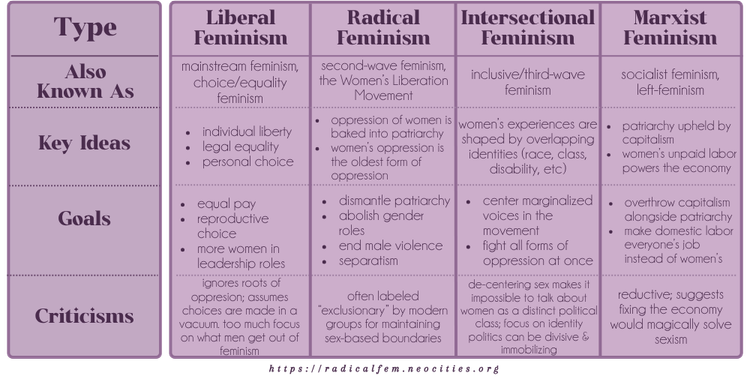
Branches of Feminism
Core Tenets of Radical Feminism
- Patriarchy must be abolished
- We reject gender roles
- The personal is political
- Women deserve bodily autonomy & reproductive freedom
- Structures such as marriage, the nuclear family, & institutionalized exploitation uphold the patriarchy
A Brief History of the Movement
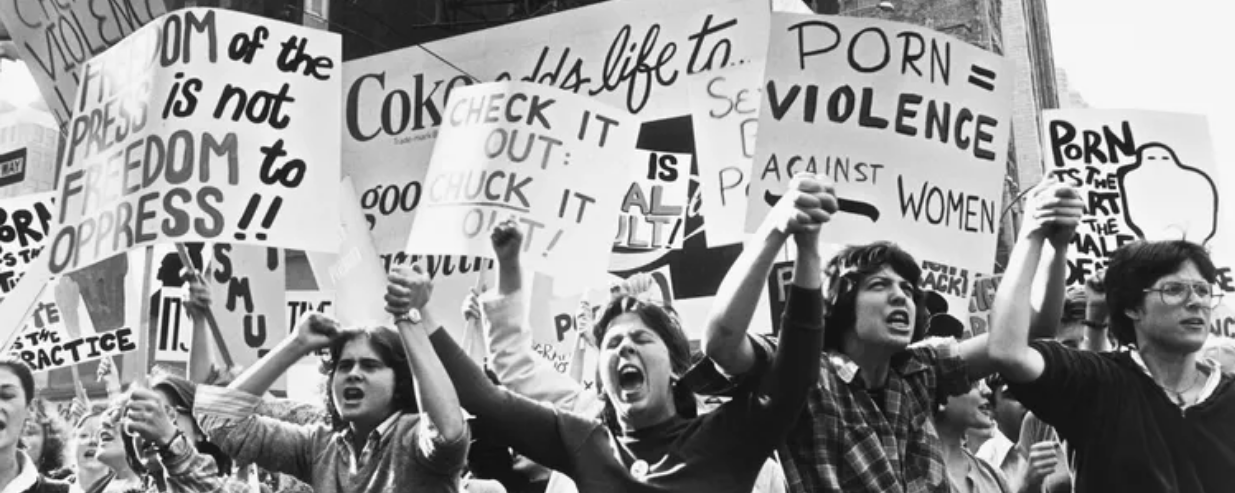
- The Emergence: In the late 1960s, women involved in civil rights & anti-war protests observed and rejected the misogyny within these progressive movements. Groups like New York Radical Women formed and spoke out publicly against issues like abortion and rape.
- The Peak: In the early 70s, the focus shifted from protests to Consciousness Raising, a strategy of collective discussion that enlightened women to the fact that their "personal" problems with men were really structural issues shared by the entire sex class. A number of important feminist works were published during this period, including The Dialectic of Sex by Shulamith Firestone and Sexual Politics by Kate Millett.
- The Split: Later during the 70s, the movement began to branch off in several different directions. Some shifted towards cultural feminism, a celebration of womanhood outside the male gaze; some focused on anti-violence, founding the first rape crisis centers and women's DV shelters; and the separatism movement was formed, arguing that the only way to overcome patriarchy was to escape it through the formation of woman-only societies.
- The Downfall: Throughout the late 70s and the 1980s, radical feminism began to lose popularity as the focus shifted to anti-pornography and anti-sex work, led by revolutionaries such as Andrea Dworkin and Catharine MacKinnon. The more popular narrative became "sex positivity," which framed porn & prostitution as empowering "choices" and eventually evolved into the liberal feminism of today.
- The Downfall (part 2): Between the 1990s - 2010s, third wave feminism became popular with the rise of postmodernism and "queer theory." This solidified radical feminism as the unpopular choice as it was increasingly labeled "exclusionary," and the movement was largely forced underground.
- The Resurgence: From around 2015 until now, the friction between sex-based rights and gender identity laws have brought radical feminism back into the spotlight; a small but passionate minority of new feminists are rediscovering 2nd wave feminism as a response to the breakdown of the concept of "women" and the subsequent efforts to repeal women's rights.
"Feminism exists so that no woman ever has to face her oppressor in a vacuum, alone."
-- Andrea Dworkin, 1989